
Tesamorelin, Ipamorelin & CJC-1295 (No DAC) Blend 12mg
$120.00
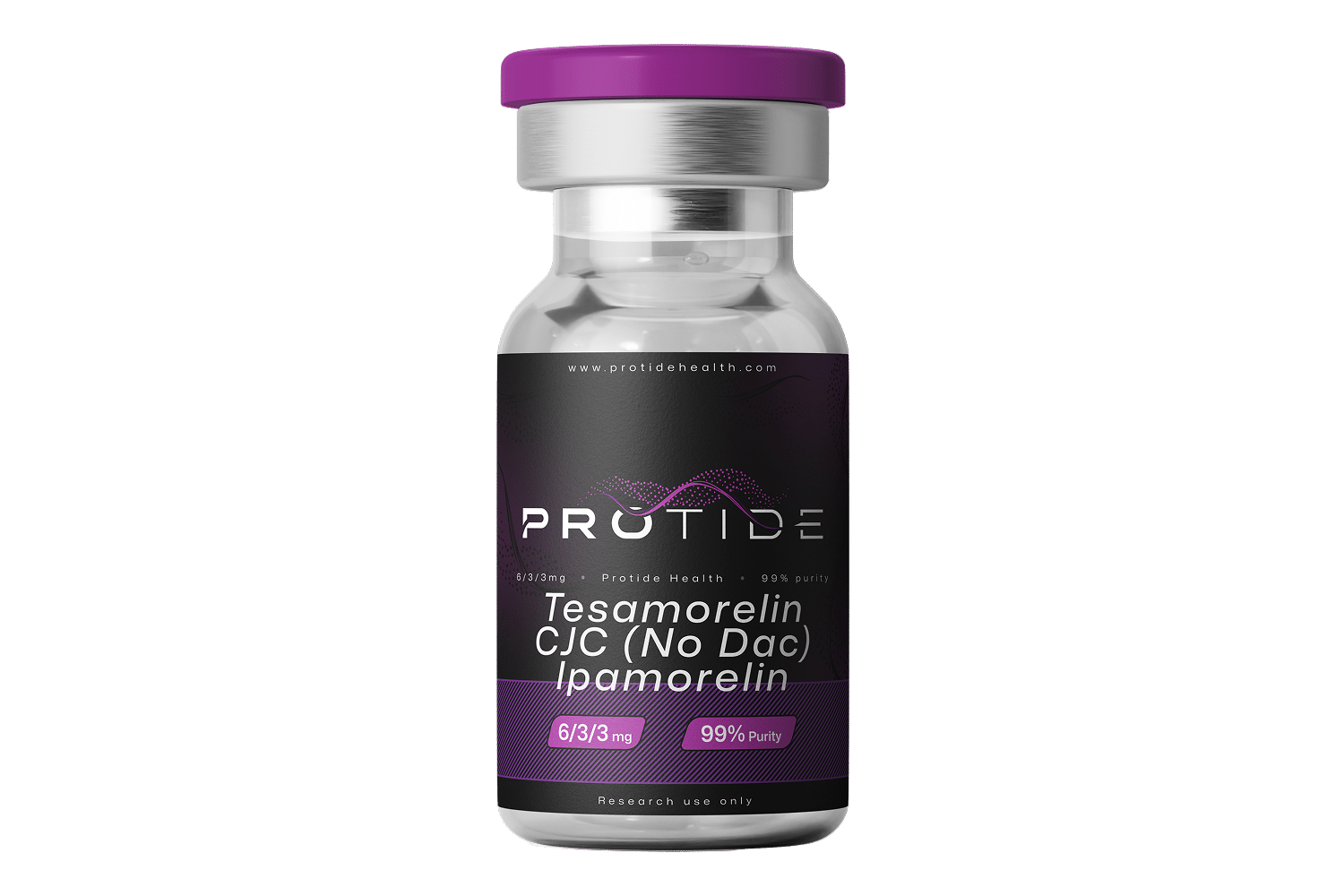
Triple-peptide blend: synthetic 44-amino-acid GHRH analog (Tesamorelin), synthetic GHS-R1a agonist pentapeptide (Ipamorelin), and synthetic 29-amino-acid GHRH analog (CJC-1295 No DAC). Available in 12mg lyophilized vials (6mg/3mg/3mg). 99% purity verified by third-party HPLC-MS testing. For research use only. Not for human use.


Every laboratory purchase decision starts with the same questions – what exactly is in the vial, how pure is it, and can the supplier show the analytical paperwork? Tesamorelin, Ipamorelin & CJC-1295 (No DAC) Blend 12mg is supplied by Protide Health Lab as a lyophilised powder with a third-party high-performance liquid chromatography and mass spectrometry (HPLC-MS) purity report, and it is intended strictly for laboratory research use.
This 12mg blend contains tesamorelin (6mg), ipamorelin (3mg) and CJC-1295 No DAC (3mg) in one vial. It stacks two GHRH-receptor-directed peptides of different lengths with a selective GHS-R1a agonist, giving researchers a single preparation that engages both the GHRH and ghrelin receptor systems. The freeze-dried presentation keeps the peptide in a form that tolerates shipping at ambient temperature while remaining suitable for long-term storage at reduced temperature once it reaches the laboratory.
Tesamorelin, Ipamorelin & CJC-1295 (No DAC) Blend 12mg Key Takeaways
- Compound class: triple-peptide secretagogue blend (tesamorelin, ipamorelin, CJC-1295 No DAC).
- Format: lyophilised research powder in a sealed glass vial.
- Vial sizes: 12mg total: 6mg, 3mg, 3mg (Tesamorelin, Ipamorelin, CJC-1295 No DAC).
- Purity: 99% (HPLC-MS verified, third-party tested).
- Price: $120 per vial.
- Fulfilment: domestic US shipping with a batch certificate of analysis.
- Status: for laboratory research use only; not for human or veterinary use.
Table of Contents
- What Is Tesamorelin, Ipamorelin & CJC-1295 (No DAC) Blend 12mg?
- Tesamorelin, Ipamorelin & CJC-1295 (No DAC) Blend 12mg Specifications
- Research Overview
- Reported Mechanism of Action
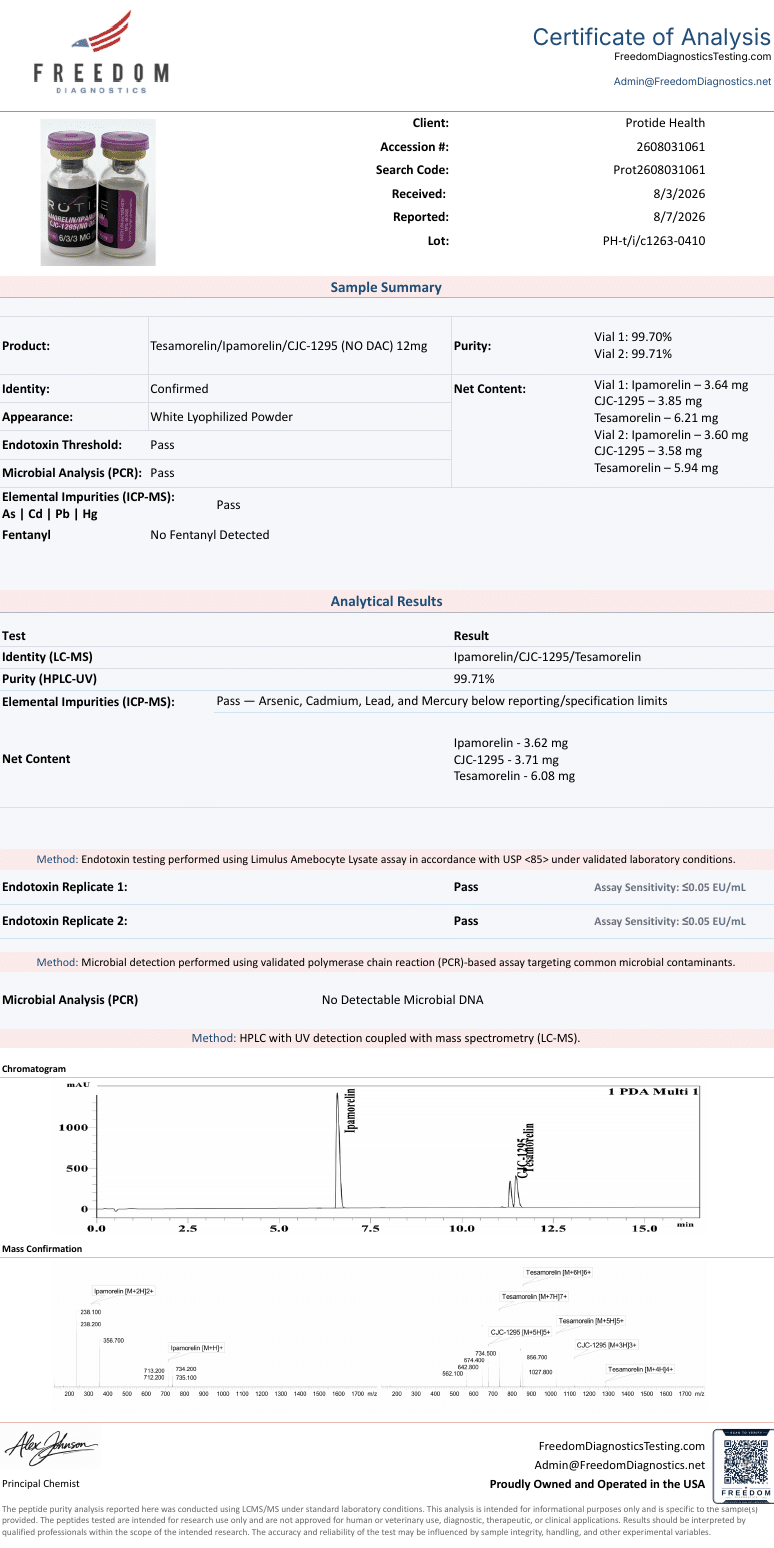
- Purity, Testing and Certificates of Analysis
- Handling, Storage and Reconstitution
- Available Sizes and Pricing
- How to Order Tesamorelin, Ipamorelin & CJC-1295 (No DAC) Blend 12mg Online
- Frequently Asked Questions
- Related Research Peptides
- References and Further Reading
What Is Tesamorelin, Ipamorelin & CJC-1295 (No DAC) Blend 12mg?
As a triple-peptide secretagogue blend (tesamorelin, ipamorelin, CJC-1295 No DAC), Tesamorelin, Ipamorelin & CJC-1295 (No DAC) Blend 12mg is offered by Protide Health Lab as a research reagent rather than as a therapeutic product. Analytical release testing covers sequence identity by mass spectrometry and purity by reverse-phase HPLC, and the outcome is documented in the certificate of analysis that accompanies the vial.
Also known as: Tesamorelin Ipamorelin CJC blend, Tesa Ipa CJC-1295, GHRH triple blend.
Because the material is sold for laboratory investigation, Protide Health Lab does not make any claim about how it should be used, and every vial is labelled with the research-use-only designation. What can be verified before purchase is the analytical record: identity, purity, batch number and the testing laboratory.
Tesamorelin, Ipamorelin & CJC-1295 (No DAC) Blend 12mg Specifications
| Property | Details |
|---|---|
| Product Contents | Tesamorelin / Ipamorelin / CJC-1295 (No DAC) Lyophilized Powder (99% purity) in 3mL vial. |
| Available Sizes | 12mg total: 6mg/3mg/3mg (Tesamorelin/Ipamorelin/CJC-1295 No DAC) |
| Peptide Type | Triple-peptide blend: synthetic 44-amino-acid GHRH analog (Tesamorelin) + synthetic GHS-R1a agonist pentapeptide (Ipamorelin) + synthetic GHRH analogue, 29 amino acids (CJC-1295 No DAC) |
| Purity | 99% (HPLC-MS verified, third-party tested) |
| Molecular Formula | Tesamorelin: C 221 H 366 N 72 O 67 S | Ipamorelin: C 38 H 49 N 9 O 5 | CJC-1295 No DAC: C 152 H 252 N 44 O 42 |
| Molecular Weight | Tesamorelin: 5135.91 g/mol | Ipamorelin: 711.86 g/mol | CJC-1295 No DAC: 3367.90 g/mol |
| Sequence | Tesamorelin: (trans-3-hexenoic acid)-YADAIFTNSY RKVLGQLSAR KLLQDIMSR QQGESNQERG ARARL-NH 2 Ipamorelin: Aib-His-D-2-Nal-D-Phe-Lys-NH2 CJC-1295 No DAC: Tyr-D-Ala-Asp-Ala-Ile-Phe-Thr-Gln-Ser-Tyr-Arg-Lys-Val-Leu-Ala-Gln-Leu-Ser-Ala-Arg-Lys-Leu-Leu-Gln-Asp-Ile-Leu-Ser-Arg-NH2 |
| CAS Number | Tesamorelin: 218949-48-5 | Ipamorelin: 170851-70-4 | CJC-1295 No DAC: 863288-34-0 |
| CID | 16137828 (Tesamorelin) | 9831659 (Ipamorelin) | 91976842 (CJC-1295 No DAC) |
| Synonyms | Tesamorelin, TH9507, Ipamorelin, NNC 26-0161, CJC-1295 No DAC, Mod GRF 1-29, Modified GRF(1-29) |
| Appearance | White to off-white lyophilized powder |
| Storage | Store at ≤6°C, sealed, away from heat, light, and moisture. |
| Solubility | Soluble in water |
The table above summarises the identity and handling parameters of the material as supplied. Sequence, molecular weight and any database identifiers are given so that the vial can be reconciled with an existing internal specification or with a literature reference.
Research Overview: Triple secretagogue receptor research
The research record for Tesamorelin, Ipamorelin & CJC-1295 (No DAC) Blend 12mg frames it as a triple-peptide secretagogue blend (tesamorelin, ipamorelin, CJC-1295 No DAC). Interest is concentrated in the following domains, each of which is presented here as a summary of published laboratory investigation only. If you are looking for buy tesamorelin ipamorelin cjc blend online, compare the batch documentation rather than the headline purity figure: sequence identity, purity method and testing laboratory matter more than a single percentage.
Triple secretagogue receptor research
Studies grouped under Triple secretagogue receptor research generally treat Tesamorelin, Ipamorelin & CJC-1295 (No DAC) Blend 12mg as a tool for examining dose-dependent changes in cellular readouts. Because these endpoints are measured in controlled culture systems, results are usually reported against a vehicle control and a reference compound, which allows the contribution of the peptide itself to be separated from assay variability. This is one of the clearest reasons to insist on batch-level analytical documentation before designing an experiment.
GHRH length and potency comparisons
In GHRH length and potency comparisons, published work typically examines Tesamorelin, Ipamorelin & CJC-1295 (No DAC) Blend 12mg from the perspective of receptor occupancy and downstream second-messenger activity. Reported findings in this area are most useful when the preparation is fully characterised, since an unquantified purity difference between batches can easily be mistaken for a biological effect. Reproducibility in this line of work depends heavily on the consistency of the starting material across repeats.
GHS-R1a co-activation studies
Research interest in GHS-R1a co-activation studies centres on how Tesamorelin, Ipamorelin & CJC-1295 (No DAC) Blend 12mg behaves at the level of gene-expression shifts and protein-level endpoints. The literature in this area is not uniform: study designs differ in concentration range, exposure time and model system, so comparisons across papers should be made with attention to those parameters. For a laboratory working in this field, the practical requirement is a peptide whose sequence identity and purity have been independently confirmed.
Release amplitude and duration endpoints
Within Release amplitude and duration endpoints, investigators use Tesamorelin, Ipamorelin & CJC-1295 (No DAC) Blend 12mg to probe enzyme kinetics and substrate handling. Endpoints here are typically quantitative – fluorescence, luminescence, chromatographic signal or imaging counts – which makes reproducible material quality a practical requirement rather than a formality. This is one of the clearest reasons to insist on batch-level analytical documentation before designing an experiment.
Receptor desensitisation models
Studies grouped under Receptor desensitisation models generally treat Tesamorelin, Ipamorelin & CJC-1295 (No DAC) Blend 12mg as a tool for examining cell-migration, proliferation and viability measurements. Because these endpoints are measured in controlled culture systems, results are usually reported against a vehicle control and a reference compound, which allows the contribution of the peptide itself to be separated from assay variability. Reproducibility in this line of work depends heavily on the consistency of the starting material across repeats.
Comparative blend pharmacology
In Comparative blend pharmacology, published work typically examines Tesamorelin, Ipamorelin & CJC-1295 (No DAC) Blend 12mg from the perspective of signalling cross-talk between converging pathways. Reported findings in this area are most useful when the preparation is fully characterised, since an unquantified purity difference between batches can easily be mistaken for a biological effect. For a laboratory working in this field, the practical requirement is a peptide whose sequence identity and purity have been independently confirmed.
Reported Mechanism of Action
Tesamorelin and Mod GRF(1-29) both signal at the GHRH receptor through cAMP and protein kinase A, while ipamorelin signals at GHS-R1a through Gq and calcium mobilisation. The blend therefore probes how two distinct GHRH analogues of different chain lengths behave alongside a secretagogue from an entirely separate receptor family, and how the combination shapes release amplitude, duration and receptor desensitisation in somatotropic models.
As with most research compounds, the mechanism described above is assembled from multiple published studies that used different concentrations, exposure times and model systems. Readers should treat it as a map of reported signalling behaviour for this triple-peptide secretagogue blend (tesamorelin, ipamorelin, CJC-1295 No DAC) rather than as a definitive account of a single pathway.
Purity, Testing and Certificates of Analysis
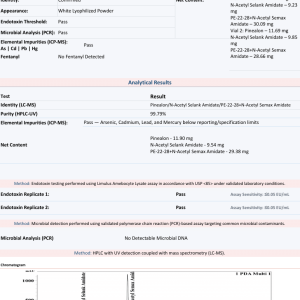
The difference between a usable research reagent and a wasted experiment is often analytical – the presence of truncated sequences, deletion products or residual solvents can shift outcomes in ways that are hard to attribute after the fact. Each batch is accompanied by a certificate of analysis that reports the analytical method, the observed purity, the identity confirmation and the testing laboratory, so the data can be filed with your study records.
Independent analysis of this material reports 99% (HPLC-MS verified, third-party tested). The certificate of analysis records the method used, the chromatographic profile, the mass-spectrometric identity confirmation and the final purity value, and it is issued against the specific batch supplied. That distinction matters: an identity confirmation from mass spectrometry establishes that the principal peak corresponds to the expected molecular mass, while the chromatographic purity figure describes how much of the total peak area that principal peak represents. A third element of quality control, which is not visible on a purity number, is the water and salt content of the lyophilised powder – residual moisture and counter-ion content both change the effective concentration of the peptide when the vial is dissolved. If your protocol requires a specific acceptance threshold, verify it against the certificate of analysis for the batch you receive before beginning work, and file that document with your study records so the material can be traced later.
Handling, Storage and Reconstitution
Storing the lyophilised powder
Before reconstitution, keep the vial frozen at -20 degrees Celsius, shielded from light, with the stopper in place and desiccant nearby if the laboratory is humid. A reconstituted solution is far less stable than the dry powder, so keep it refrigerated at 2 to 8 degrees Celsius and treat the working window as short.
Reconstitution
Most peptides in this catalogue dissolve readily in bacteriostatic water or in a 0.9% benzyl alcohol solution; a preserved diluent is often preferred when a multi-use vial will be drawn from repeatedly.
To calculate a working concentration, divide the mass of peptide in the vial by the volume of diluent added. For example, a 12mg total: 6mg vial dissolved in 2 mL of diluent gives approximately 6 mg/mL per mL. A convenient shorthand is that a 10mg vial dissolved in 2mL of diluent gives a 5mg/mL stock, while the same vial dissolved in 5mL gives 2mg/mL. Add the diluent slowly down the wall of the vial rather than directing the stream onto the powder, swirl gently instead of shaking, and never vortex a peptide solution: mechanical shear and foaming both encourage aggregation.
Laboratory handling practice
Prepare and handle Tesamorelin, Ipamorelin & CJC-1295 (No DAC) Blend 12mg in an appropriate laboratory environment using clean technique. Work with gloves and eye protection, use dedicated glassware or single-use labware, and label every aliquot with the compound name, concentration, batch number and preparation date. When drawing from a multi-use vial, swab the stopper before and after use and keep the needle small to reduce coreing. Avoid repeated freeze-thaw cycles, because each thaw exposes the peptide to a fresh round of hydrolysis and aggregation; prepare single-use aliquots instead. Dispose of all peptide waste in accordance with your institution’s chemical-waste policy, and record the batch number in your laboratory notebook so that any analytical outlier can be traced back to a specific vial.
Available Sizes and Pricing
Tesamorelin, Ipamorelin & CJC-1295 (No DAC) Blend 12mg is supplied as a single 12mg total: 6mg vial priced at $120.
Choosing a size is largely a question of how many separate preparations your protocol requires. Consolidating into one larger vial reduces handling steps and the associated risk of variability, while small vials keep unused material in the more stable dry state for longer.
How to Order Tesamorelin, Ipamorelin & CJC-1295 (No DAC) Blend 12mg Online
Domestic orders are processed promptly, packed discretely and shipped with tracking, with the certificate of analysis included for your records. Browse the full Peptides > Peptide Blends category listing, or compare other compounds in the same family: Tesamorelin & Ipamorelin Blend, CJC-1295 (No Dac) & Ipamorelin Blend, Tesamorelin.
Protide Health Lab supplies Tesamorelin, Ipamorelin & CJC-1295 (No DAC) Blend 12mg from domestic inventory with same-day dispatch for orders received before the daily cut-off. Each order includes the batch-matched certificate of analysis, and shipment tracking is provided so that delivery can be confirmed. Keep the vial closed until it reaches the laboratory, then store it as described in the handling section above.
Frequently Asked Questions
What is Tesamorelin, Ipamorelin & CJC-1295 (No DAC) Blend 12mg?
This 12mg blend contains tesamorelin (6mg), ipamorelin (3mg) and CJC-1295 No DAC (3mg) in one vial It is supplied as a research reagent for in-vitro laboratory investigation, not as a therapeutic product..
What purity is Tesamorelin, Ipamorelin & CJC-1295 (No DAC) Blend 12mg supplied at?
The material is released against independent analytical testing, with a reported purity of 99% (HPLC-MS verified, third-party tested). The certificate of analysis for your specific batch records the method used, the chromatographic profile and the mass-spectrometric identity confirmation, and it ships with the order.
What vial sizes of Tesamorelin, Ipamorelin & CJC-1295 (No DAC) Blend 12mg are available?
Tesamorelin, Ipamorelin & CJC-1295 (No DAC) Blend 12mg is supplied as a single 12mg total: 6mg vial.
How much does Tesamorelin, Ipamorelin & CJC-1295 (No DAC) Blend 12mg cost?
Tesamorelin, Ipamorelin & CJC-1295 (No DAC) Blend 12mg is priced at $120 per vial, and the batch certificate of analysis is included with the order.
What is Tesamorelin, Ipamorelin & CJC-1295 (No DAC) Blend 12mg supplied as?
It is supplied as a lyophilised (freeze-dried) powder in a sealed glass vial. The dry format is the most stable way to ship and store a research peptide, and it keeps the material usable for longer than a pre-dissolved solution would.
How should Tesamorelin, Ipamorelin & CJC-1295 (No DAC) Blend 12mg be stored?
Keep the sealed vial frozen at -20 degrees Celsius, protected from light, until you are ready to use it. After reconstitution, store the solution at 2 to 8 degrees Celsius and use single-use aliquots to avoid repeated freeze-thaw cycling, which accelerates hydrolysis and aggregation.
What diluent should be used to reconstitute Tesamorelin, Ipamorelin & CJC-1295 (No DAC) Blend 12mg?
Bacteriostatic water is the usual choice; a preserved 0.9%% benzyl alcohol solution is a practical alternative when the same vial will be drawn from repeatedly. Add the diluent slowly down the vial wall, swirl gently and never vortex, because mechanical shear promotes aggregation. Divide the vial mass by the volume added to obtain your working concentration.
Is Tesamorelin, Ipamorelin & CJC-1295 (No DAC) Blend 12mg intended for human use?
No. This product is a research chemical supplied for in-vitro laboratory investigation only. It is not intended for human or veterinary use, and it is not a treatment, diagnostic or supplement.
How can I confirm the certificate of analysis for my batch?
The certificate of analysis is matched to the batch number printed on the vial and is included with the shipment. Compare the reported purity and identity data against the acceptance criteria in your protocol and file the document with your study records so the material remains traceable.
Related Research Peptides
Researchers who work with Tesamorelin, Ipamorelin & CJC-1295 (No DAC) Blend 12mg frequently also examine the compounds below, either as alternatives within the same signalling family or as complementary reagents in a combined study design.
- Tesamorelin & Ipamorelin Blend – dual-peptide blend of tesamorelin and ipamorelin.
- CJC-1295 (No Dac) & Ipamorelin Blend – dual-peptide blend of Mod GRF(1-29) and the ghrelin receptor agonist Ipamorelin.
- Tesamorelin – synthetic 44-amino-acid GHRH analogue.
- Sermorelin – synthetic 29-amino-acid GHRH(1-29) amide.
The complete research catalogue is available on the https://protidehealthlab.store/shop/ page. If you are unsure which vial size fits your protocol, order the smaller size first, confirm that the material meets your acceptance criteria against the certificate of analysis, and scale up once the preparation has performed as expected. Every listing shows the analytical documentation for the batch, so the material can be evaluated on evidence before it is ordered.
References and Further Reading
The links below point to publicly indexed literature and reference resources relevant to this compound class. They are provided so that the mechanistic summaries above can be traced to their sources. Access to full text depends on the subscription arrangements of your institution.
- Peer-reviewed literature indexed in PubMed (PMID 18840302)
- Peer-reviewed literature indexed in PubMed (PMID 12094662)
- PubMed – biomedical literature database maintained by the National Library of Medicine
- National Institutes of Health – public research and health information resources
Research Use Only Disclaimer
This product is sold strictly as a chemical reference material for in-vitro laboratory research and is not a drug, supplement, cosmetic or food. It must not be administered to humans or animals, must not be used for diagnostic or therapeutic purposes, and must be handled only by qualified personnel in an appropriate laboratory setting. Statements describing areas of scientific interest are summaries of published research literature and do not constitute claims of efficacy, safety or intended use. By purchasing, the buyer confirms that they are a qualified researcher and that the material will be used lawfully within an institutional or laboratory research context.
Be the first to review “Tesamorelin, Ipamorelin & CJC-1295 (No DAC) Blend 12mg”
Related products
Melanotan Peptides
Peptides
Peptides
Copper Peptides
Peptides
Peptide Blends
Copper Peptides
Peptide Blends
Reviews
There are no reviews yet.